
Blog
Where to Buy Microneedling Cartridges: A Clinic Owner’s Sourcing Guide

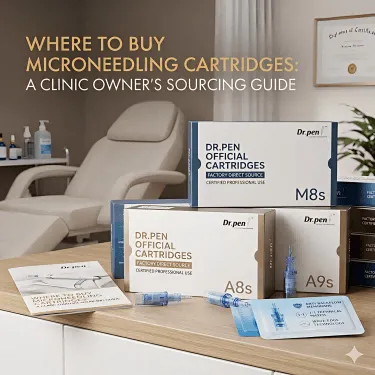
The old rule in med-spa purchasing was simple enough: never put all your eggs in one basket. So you bought needles from one place, serums from somewhere else, devices from a third. It felt like smart business. Spread the risk. Keep options open. Play vendors against each other when you could. But walk into the back office of any clinic that has been running for five years or more, and you will often find something different happening. The owner who used to juggle four suppliers is now down to one. Not because of loyalty. Because they got tired.
What Multiple Vendors Actually Costs You
On paper, having three needle suppliers looks like prudent procurement. You compare prices. If one runs dry, you have backups. You might even leverage one quote against another. This all makes sense in an MBA textbook.
Monday morning at a real clinic looks different. It means logging into three separate portals to check whether orders shipped. It means reconciling three invoices with three different payment terms at month-end. It means remembering which vendor uses FedEx and which ships DHL, which one requires a minimum order of fifty units and which will let you order twenty. When a client asks about your next opening and you have to pause because you are mentally tracking whether the 36-pin cartridges from Vendor B actually arrived yesterday, that is a problem that does not show up on any P&L statement but absolutely affects how your practice runs day to day.
This fragmented approach does not save money. What it does is fragment your attention. And attention is the one resource a growing clinic cannot afford to waste.
The Real Math: Cost Per Headache
Most clinic owners still evaluate suppliers on unit price. Two dollars eighty cents a cartridge versus three twenty. The math seems obvious until you factor in what happens between placing an order and actually using the product.
There is the shipment that arrives two days late because the vendor’s warehouse had a “system issue.” You reschedule four treatments. Those are four revenue slots you never get back. There is the batch where the sterile seals look slightly different from the last order and you spend an entire treatment wondering, not about your technique, but about whether this cartridge is safe. There is the hour spent on email trying to track down someone who can tell you where your order actually is. That hour could have gone toward updating your website, training a new staff member, or simply leaving work on time for once.
Add up these hidden line items across six months, and the Dr Pen M8S cartridges supplier charging slightly more per box but delivering on time, every time, with consistent quality and someone who picks up the phone suddenly becomes the cheapest option. Not because their price is lowest. Because their price is the only one that matters once you stop subsidizing chaos with your own time.
The Shift Happening Now in Clinic Procurement
This is not theory. Talk to anyone who has owned a med-spa for more than three years and they will describe the same arc. Year one is chaos, trying everyone, chasing deals. Year two is narrowing it down. By year three or four, most successful clinic owners have settled on one primary source for each major consumable category. Not out of brand loyalty or laziness. Out of exhaustion with the alternative.
The clinics getting ahead in 2026 are the ones making this choice intentionally rather than drifting into it. They are looking at their supply chain as a strategic asset rather than a nuisance to be managed. A single reliable source for microneedling needle cartridges wholesale means your front desk knows exactly where to order from. Your inventory spreadsheet has one row instead of five. Your budget forecasts actually match reality because pricing is stable and predictable. These sound like small things. Compound them over twelve months of operations and the difference between a streamlined practice and a scattered one becomes impossible to ignore.
What “Trust Dividend” Actually Means in Practice
When you stick with one supplier long enough, something shifts. They learn your patterns. They know you tend to reorder 36-pin cartridges every third week, that you stock up before Q4, that you prefer certain configurations for specific treatments. A good supplier starts anticipating needs before you articulate them. They flag potential delays proactively. They suggest alternatives when something is backordered based on what they know works for your practice.
This is what a relationship looks like versus a transaction. Transactions are fine for buying printer paper. For tools that go onto a client’s face, you want something closer to a partnership. The trust dividend shows up in ways that are hard to quantify but impossible to miss. It shows up in the confidence you feel walking into a treatment room knowing exactly what is in your cabinet. It shows up in the time you save not researching alternatives every quarter. It shows up in the peace of mind that comes from knowing your single source needle supplier medspa relationship is solid enough that you genuinely do not need to think about it.
The Old Logic Versus the New Reality
Diversification made sense when suppliers were unreliable and information was scarce. You needed backups because failure was common and finding alternatives was hard. Neither of those conditions applies the same way today. The best suppliers have built systems specifically to earn and keep long-term clients. They invest in reliability precisely because they know that a clinic owner who switches to them is looking for a permanent home, not a fling.
Streamline clinic supply chain is not just operational advice anymore. In a service industry built on precision and consistency, having a supply chain you can set and forget is a genuine competitive edge. Every minute your peers spend troubleshooting orders, comparing quotes, and fielding vendor calls is a minute you spend on client results, team development, and building the reputation that drives word-of-mouth growth.
The goal was never to become an expert in logistics. The goal was to run a practice where the tools show up, the quality holds steady, and the person supplying them feels less like a vendor and more like a quiet extension of your own operation. When you reach that point, the question of where to buy your next box of needles stops being a question at all. And that is exactly where you want to be.