
Blog
Microneedling + Mesotherapy Protocol Guide: H12, H36 & Nano Cartridge Selection for Med-Spa Professionals

The global microneedling market is on track to exceed $1.1 billion by 2030, growing at roughly 9.5% annually — and the fastest-growing segment within it is microneedle mesotherapy, projected to reach $2.9 billion by 2035. Those numbers reflect something practitioners already know: clients are no longer satisfied with single-modality treatments. They want protocols that address multiple concerns in one session and deliver measurable, repeatable results.
But designing a combination microneedling + mesotherapy program that’s both clinically sound and operationally efficient is more nuanced than simply loading a serum into a device. Cartridge selection, needle configuration, serum formulation, and session structure all interact. Get the combination right, and you have a protocol that generates consistent outcomes and strong client retention. Get it wrong, and you have inconsistent results, frustrated clients, and an expensive device that underperforms.
This guide covers what the clinical evidence actually shows, how to structure a session, which needle configurations to use for which goals, and what the data says about the business case for doing this well.
What the Clinical Research Actually Shows About Combination Protocols
The evidence base for microneedling combined with active ingredient delivery has strengthened significantly in recent years. A 2024 network meta-analysis published in Archives of Dermatological Research (Springer/Nature) analyzed 24 randomized controlled trials involving 1,546 participants and found that every combination microneedling protocol outperformed microneedling alone. The hierarchy of efficacy for acne scar outcomes ran: microneedling + chemical peel > microneedling + PRP > microneedling + hyaluronic acid > microneedling alone. Critically, safety profiles were equivalent across all groups — the combinations delivered better results without meaningfully higher risk.
For skin aging specifically, a 2024 study in Aesthetic Cosmetology Medicine documented that a course of microneedle mesotherapy treatments produced skin hydration improvements of 30–50%, wrinkle depth reductions of 20–40%, and a 15–25% increase in dermal collagen density as measured by histological analysis. A separate split-face comparative study published in MDPI Cosmetics in 2025 — which used Corneometer, Cutometer, and VISIA imaging to objectively measure outcomes — found that microneedle-assisted mesotherapy was non-inferior to conventional needle mesotherapy on hydration, fine lines, and elasticity, while patients reported greater comfort.
For context on safety: a 2021 systematic review in the Journal of Clinical and Aesthetic Dermatology analyzed 51 studies covering 1,029 patients and found that infection after professional microneedling is extremely rare — only 2 cases were documented across all included studies, both in unusual circumstances. The expected side effects (erythema in 83.7% of pen-treated patients, mild edema, temporary discomfort) resolve within 3–7 days and are predictable. A well-structured protocol with appropriate cartridges, sterile technique, and the right serum formulation carries a very low complication profile when executed by a trained professional.
Choosing the Right Needle Configuration for the Treatment Goal
One of the most consequential decisions in building a combination protocol is needle configuration. Cartridge selection determines penetration depth, coverage efficiency, the mechanical stimulus to collagen, and serum delivery precision. Using the same cartridge for every client and every goal is one of the most common efficiency mistakes in clinical microneedling.
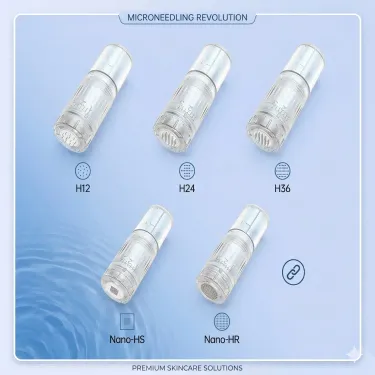
The H36 configuration — 36 closely packed fine needles — is the clinical workhorse for general skin rejuvenation and mesotherapy infusion. It creates high-density micro-channels across a large area efficiently, which makes it ideal for full-face hydration protocols, fine line treatment, and distributing active ingredients like hyaluronic acid, niacinamide, and peptides evenly across the treatment zone. Industry data confirms this: the 36-pin cartridge is the most frequently used configuration in professional clinics for routine anti-aging work.
The H12 configuration — 12 heavier, more rigid needles — is purpose-built for targeted depth work. Its design concentrates force, enabling effective penetration to 1.0–2.0mm for deep scar remodeling, structural wrinkles, and stretch marks. Because it covers less surface area per pass, it’s slower but more precise. Use it when the treatment goal is intensive collagen induction in a defined zone, not broad-surface mesotherapy delivery.
The Nano cartridge operates at 0.15–0.25mm — it doesn’t penetrate into the dermis in any meaningful way. What it does is create surface-level channels that dramatically increase transepidermal absorption of active ingredients, without creating a wound response or requiring downtime. This makes it the ideal configuration for mesotherapy-focused sessions on sensitive clients, for the neck and décolletage, or as part of a low-trauma maintenance protocol between deeper treatment courses.
In practice, many Med-Spas treating full-face aging stock all three configurations and protocol them by client profile: the H36 for the foundational annual rejuvenation course, the H12 for targeted scar work or perioral lines, and the Nano for monthly maintenance or add-on service upgrades. The 3ml auto-dispensing format of the Hydra Pen H5 cartridges supports all three configurations with consistent flow rate — relevant because serum delivery during Nano or H36 passes needs to be metered and controlled, not manually pumped or estimated.
| Configuration | Penetration Depth | Best For | Serum Delivery Role |
|---|---|---|---|
| H36 | 0.25–1.0 mm | Full-face rejuvenation, fine lines, general mesotherapy | Broad, even distribution — ideal for HA, peptides, niacinamide |
| H12 | 0.25–2.0 mm | Deep scars, structural wrinkles, stretch marks | Targeted infusion at higher depth — PDRN, growth factors, PRP serums |
| Nano | 0.15–0.25 mm | Sensitive skin, maintenance, no-downtime mesotherapy | Maximum superficial absorption — vitamins, brightening agents, hydrators |
Serum Selection by Treatment Goal
Microneedling dramatically increases dermal absorption — but this works both ways. Active ingredients penetrate more deeply and efficiently, which is the therapeutic benefit. It also means formulations that would be benign topically can cause unexpected reactions when delivered intradermally through open channels. Three documented cases in the 2021 systematic review involved delayed hypersensitivity reactions — including fever, joint pain, and nodular erythema — following microneedling with vitamin C serum application, underscoring that ingredient selection matters more in this context than in standard topical skincare.
The practical guidelines from clinical evidence and professional protocols converge on a few clear principles. For anti-aging and collagen stimulation, the most evidence-supported ingredients are hyaluronic acid (any molecular weight works given the open channels), copper peptides, and PDRN (polydeoxyribonucleotide) — the latter showing particular efficacy for tissue regeneration and wound healing. For brightening, niacinamide and tranexamic acid have strong safety and efficacy profiles when delivered post-needling. For barrier repair and maintenance sessions, ceramides and panthenol are well-tolerated and support the healing response.
What to avoid during active mesotherapy delivery: strong vitamin C formulations (L-ascorbic acid at high concentrations), AHAs and BHAs, retinoids, fragrance compounds, and alcohol-based preservatives. These can trigger inflammatory responses in breached skin and may produce results you’ll have to explain to the client. The safest rule is: if you wouldn’t put it on an open wound, don’t deliver it through a needled surface.
Structuring the Session: A Repeatable Clinical Protocol
A well-structured combination session has three phases, and the timing within each phase is as important as the treatment itself.
Preparation (30–40 minutes before treatment): Deep cleanse to remove cosmetics, oils, and surface contamination. Apply topical anesthetic under occlusion for 30–40 minutes — adequate anesthesia is the single biggest factor in patient comfort and compliance for repeat treatments. Remove thoroughly with saline, then disinfect with medical-grade alcohol. A rushed prep is the most common cause of client dissatisfaction in subsequent sessions.
Treatment phase: For a combination protocol, run the microneedling pass first to establish the micro-channels, then deliver the mesotherapy serum through the same channels while they are open. Needle depth should be adjusted by facial zone — periorbital areas: ≤0.5mm; cheeks and forehead: 0.5–1.5mm depending on treatment goal; nasolabial region: 0.5–1.0mm. For most anti-aging mesotherapy protocols, the H36 at 0.5–0.75mm covers the face efficiently in one pass with the 3ml cartridge. A single-face treatment at this protocol consumes approximately 1.5–2.5ml of serum — the 3ml cartridge volume is calibrated to complete a full-face session without a mid-treatment reload, which is the operational reason the capacity matters.
Recovery phase (20–30 minutes): Apply cooling masks or medical-grade soothing topicals immediately post-treatment. This is not downtime filler — it’s an active part of the protocol that reduces peak erythema, modulates the inflammatory response, and significantly improves the client’s immediate post-treatment experience. Clients who leave looking and feeling better are more likely to book the next session in the course.
Standard course structure: 3–6 sessions, spaced 2–4 weeks apart, followed by maintenance every 3–6 months. The clinical evidence supports this interval — sufficient time for the collagen induction cycle to complete between sessions while maintaining treatment momentum.
The Business Case: Why This Protocol Pays
The American Med Spa Association’s 2024 State of the Industry Report documented that Med-Spa client retention rates rose from 65% to 73% between 2022 and 2024 — a sign that aesthetic treatments are becoming routinized rather than occasional. That shift creates the conditions for combination protocols to outperform single-treatment services: clients committed to a regular treatment cadence are far more likely to purchase 3- or 6-session courses and to upgrade to add-on services like PDRN serums or advanced cartridge configurations.
The revenue math is straightforward. Standard microneedling runs $300–$600 per session at most Med-Spas. Adding a targeted mesotherapy serum upgrade ($50–$150 per session at a typical margin) with a premium cartridge configuration adds roughly 15–30% per-session revenue with minimal incremental time cost. A provider running 6–8 combination sessions per day on a structured annual protocol can generate $200,000–$400,000 annually in this service alone (RunMedSpa, 2026). The key to hitting the upper end of that range is protocol consistency — predictable results build referral volume.
The microneedle mesotherapy segment specifically is growing at 9.6% annually and is projected to reach $2.9 billion globally by 2035 (Makdata Insights). The 10,488 Med-Spas operating in the US as of 2023 are competing in a market where combination protocols are becoming the standard expectation for clients in the core 35–55 age demographic — the segment that drives 54% of Med-Spa revenue and consistently demonstrates the highest treatment loyalty.
In this environment, the operational details that determine whether a protocol runs smoothly — cartridge flow consistency, session continuity, sterile technique, reliable device performance — are not marginal considerations. They are the variables that determine whether a $400-per-session service is repeatable at scale or dependent on everything going right on a given day.
Screening and Contraindications
No protocol guide is complete without the cases where you should not proceed. Active skin infections (herpes simplex, acne in active breakout phase, fungal infections) are absolute contraindications — open channels in infected skin create pathways for systemic spread. Patients with clotting disorders or on anticoagulant therapy require medical clearance. Pregnancy is a contraindication due to skin sensitivity changes and the unknown systemic effect of mesotherapy actives in the context of open dermal channels.
For patients with Fitzpatrick skin types IV–VI, parameters should be conservative: shallower depth settings, longer intervals between sessions, and serums that minimize post-inflammatory hyperpigmentation risk (specifically avoiding formulations that provoke strong inflammatory responses). The 2021 systematic review documented PIH rates of 6.8% with roller devices and 6.6% with RF microneedling — a clinically meaningful complication in darker skin tones that is largely preventable with appropriate parameter adjustment.
Building the Protocol Into Your Menu
The practical starting point for most Med-Spas is a standardized 3-session foundational course: H36 cartridge at 0.5–0.75mm, HA + peptide serum for the mesotherapy component, 2–4 week intervals, recovery mask included. This covers the largest segment of your client base, produces reliable results the clinical evidence supports, and gives you a protocol you can train your team to execute consistently.
From that foundation, you layer in targeted upgrades: H12 sessions for clients with structural scar concerns, Nano sessions as monthly maintenance between deeper courses, PDRN or growth factor serums for clients investing in more intensive regenerative outcomes. Each layer is a discrete service offering with a defined protocol and a justifiable price point — not a vague premium.
For reliable cartridge supply for your Hydra Pen H5 protocols — H36, H12, H24, and Nano configurations in the 3ml auto-dispensing format — genuine Hydra Pen H5 replacement tips are available at Billsu. Consistent cartridge performance across all four configurations is what makes the protocol structure described here operationally reliable rather than aspirational.
Frequently Asked Questions
How many sessions does a standard microneedling + mesotherapy course require?
Clinical protocols and the supporting research consistently indicate 3–6 sessions spaced 2–4 weeks apart as the standard initial course. Most clients see meaningful improvement by session 3; the full collagen remodeling cycle benefits from completing the course. Maintenance sessions every 3–6 months sustain outcomes.
Which needle configuration is best for mesotherapy serum delivery?
For broad mesotherapy infusion (hydration, brightening, anti-aging serums across the full face), the H36 configuration is the most efficient — high-density micro-channels, good surface coverage, and appropriate depth for superficial-to-mid dermal delivery. For targeted delivery of regenerative actives (PDRN, growth factors) into deeper tissue layers, H12 at 1.0–1.5mm is appropriate. The Nano configuration maximizes epidermal absorption for sensitive-skin or maintenance protocols.
What serums should not be used during active microneedling treatment?
Avoid strong vitamin C formulations (L-ascorbic acid at high concentrations), AHAs, BHAs, retinoids, and products containing fragrance or alcohol-based preservatives. These can trigger inflammatory reactions through open dermal channels. Evidence-backed safe choices for active delivery include hyaluronic acid, peptides, PDRN, niacinamide, tranexamic acid, ceramides, and panthenol.
How does the 3ml cartridge volume affect treatment workflow?
A standard full-face combination protocol at 0.5–0.75mm depth with H36 configuration uses approximately 1.5–2.5ml of serum. The 3ml auto-dispensing cartridge is calibrated to complete this treatment zone in a single continuous pass without mid-session reloading — which matters both for procedural efficiency and for consistent serum distribution across the treatment area.
References
- Jaiswal S, Jawade S. Microneedling in Dermatology: A Comprehensive Review of Applications, Techniques, and Outcomes. Cureus, September 2024.
- Comparing the efficacy and safety of microneedling and its combination with other treatments in patients with acne scars: a network meta-analysis of randomized controlled trials. Archives of Dermatological Research, Springer/Nature, 2024.
- Gowda A, Healey B, Ezaldein H, Merati M. A Systematic Review Examining the Potential Adverse Effects of Microneedling. Journal of Clinical and Aesthetic Dermatology, 2021.
- Microneedle Mesotherapy for Skin Aging. Aesthetic Cosmetology Medicine, October 2024.
- Efficacy of Needle and Microneedle Mesotherapy in Reducing Signs of Skin Aging — A Split-Face Comparative Study. MDPI Cosmetics, 2025.
- 2024 Medical Spa State of the Industry Report. American Med Spa Association (AmSpa), November 2024.
- Global Microneedle Mesotherapy Market: $2.9B by 2035 at 9.6% CAGR. Makdata Insights.
- Med Spa Microneedling: How to Add $200K+ in Annual Revenue. RunMedSpa, 2026.
- Microneedling Cartridge Types Explained: 12-Pin vs 36-Pin vs Nano. Rose Orchid, 2026.
- Microneedling Market Size & Share Analysis. Mordor Intelligence, 2025.