$75 with free shipping, buy now!

Beyond the Sterile Seal: What Actually Makes a Microneedling Cartridge Safe

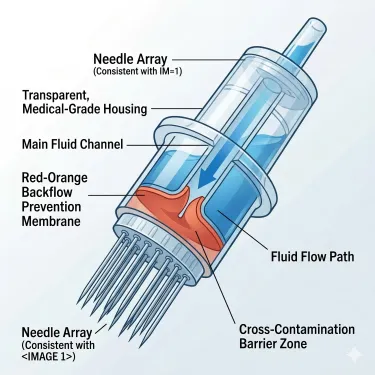
You open a fresh box of needle cartridges. The sterile seal is intact. The packaging looks professional. You peel back the blister, load it into your pen, and carry on with your day. For most practitioners, that quality check begins and ends with that seal. It is a necessary step, but it is also the absolute minimum. That sealed pouch represents the final chapter of a much longer story — one that starts in a factory you have never seen, with raw materials you have never inspected, under standards you might not realize exist.
What That Sterile Seal Does Not Tell You
The seal confirms one thing: this specific unit went through a sterilization cycle before it was packaged. That matters, obviously. But consider what it cannot confirm. It cannot tell you whether the medical grade stainless steel inside meets the alloy specifications that keep the needle tip sharp and corrosion-resistant through hundreds of insertion cycles. It cannot reveal whether the manufacturing floor where that needle was formed met the particulate control standards of an operating theater, or whether dust and machine oil were present during production. It certainly cannot document whether the factory holds an ISO 13485 certification, maintains batch-level traceability, or has ever undergone an unannounced regulatory audit.
In other words, the sterile seal is a promise about the last step. Everything before that last step depends entirely on who made the needle and what systems they had in place while making it.
Decoding the Acronyms: ISO, FDA, CE
You see them on websites and packaging: ISO. FDA. CE. They look like badges, and to some extent they are. But understanding what each one actually represents changes how you evaluate the Dr Pen M8S cartridges sitting in your supply cabinet.
FDA clearance means a device has been reviewed through either the 510(k) pathway (demonstrating equivalence to an already-cleared device) or the De Novo pathway (for novel low-to-moderate risk devices). In the microneedling world, this typically results in a Class II designation with product code QAI. The important detail here is that FDA clearance is not about the single device in your hand. It is about the manufacturer’s entire system for producing that device consistently. Documentation, process controls, clinical data, labeling compliance — all of it gets scrutinized before a device can legally be marketed in the United States.
ISO 13485 operates at a different level. It is not a government regulation like FDA clearance. It is an international standard specifically designed for medical device quality management systems. A manufacturer that holds current ISO 13485 certification has been audited by a third-party body (TÜV SÜD, BSI, NSF, or similar) and proven that their design controls, risk management protocols, supplier evaluation processes, and post-market surveillance systems meet globally recognized benchmarks. When you see ISO 13485 on a supplier’s credentials, it means there is a documented system backing every needle they produce — not just the one you are holding today, but the one you will order six months from now.
CE marking indicates conformity with the European Union’s Medical Device Regulation (MDR EU 2017/745). For microneedling cartridges, this usually places the product in Class IIa, requiring assessment by a Notified Body before the mark can be applied. The CE system emphasizes biocompatibility testing under ISO 10993 standards — cytotoxicity, sensitization, irritation studies that verify the materials will not cause adverse reactions when in prolonged contact with human tissue. Between FDA clearance and CE marking, you get coverage of two major regulatory frameworks with overlapping but distinct requirements.
The Geography of Manufacturing Quality
Every needle cartridge begins as raw stainless steel. Whether it ends up precise and consistent or marginally variable depends almost entirely on what happens between those two points. The steel itself should be 316L or 304 medical-grade stainless steel — alloys chosen for corrosion resistance, tensile strength, and biocompatibility. Lower-grade substitutes exist, and they cost less, but they also dull faster, resist cleaning less effectively, and carry higher risks of nickel leaching or allergic response in sensitive clients.
From there, the manufacturing environment becomes critical. Serious producers fabricate needles inside clean room manufacturing standards environments — ISO Class 7 facilities or better, where particle counts per cubic foot are strictly controlled. Air filtration systems run continuously. Personnel wear full cleanroom gowns, gloves, and hairnets. The machinery that cuts, grinds, and forms each needle is calibrated to tolerances measured in microns. Any deviation triggers an automatic halt and a root-cause investigation. This level of control exists precisely because contaminants introduced during manufacturing — metal shavings, cutting fluid residue, ambient dust — can become permanently encapsulated when the final blister pack gets heat-sealed. After that point, even perfect EO gas sterilization may not fully address what was locked inside.
Ethylene oxide (EO) gas remains the most common sterilization method for microneedling cartridges because it penetrates packaging layers effectively and reaches irregular surface geometries that other methods miss. Gamma irradiation is the main alternative. Both are validated processes when executed correctly, but both depend entirely on the pre-sterilization condition of the product. You cannot sterilize your way out of a contamination problem that was manufactured into the part.
Traceability: The Paperwork That Protects Your Practice
Here is a scenario nobody likes to imagine but everyone should prepare for. A client has an unexpected reaction — nothing life-threatening, but enough to raise questions. A regulatory auditor appears and asks about your sourcing chain. In those moments, a sterile seal provides exactly zero useful information. What matters then is whether someone can produce a needle cartridge batch traceability file showing the manufacturing date, sterilization lot number, material certificate of analysis, and quality release signature for the exact batch that caused the issue.
This documentation layer is what separates a disposable commodity from a properly sourced medical component. Suppliers connected to ISO 13485-certified manufacturers maintain these records by default. They can tell you which facility produced a given batch, when it was sterilized, what method was used, and when it expires. Suppliers who source from untracked or loosely managed factories often cannot — or will deflect when asked. The difference is not academic. In an audit or liability situation, it is the difference between a confident answer and an awkward silence.
The Hidden Cost of an Invisible Compromise
The market is full of needle cartridges that look identical to premium ones. Same shape, similar packaging, comparable price-per-unit on the invoice. The compromise is never visible in the product itself. It lives in the slight variation in needle geometry that affects penetration consistency. It lives in the uncertainty around whether the sterilization cycle was actually validated. It lives in the absence of anyone to call when something goes wrong.
Microneedling infection risk prevention starts long before a client sits in your chair. It starts with the material choices a manufacturer makes, the cleanliness of the floor where needles are assembled, the rigor of the quality checks between production steps, and the completeness of the records kept after the product ships. Each of these invisible factors compounds into either a reliable tool or a question mark you carry through every treatment.
Choosing a supply partner is, in practical terms, deciding how much of this process you are willing to take on faith versus how much you want verified and documented. The lowest-priced option on the market is only the cheapest if you ignore everything that happens before the box arrives.
Building Your Practice on Documented Foundations
The clinics that operate with the greatest calm tend to share one habit: they treat their consumables supply chain with the same seriousness they apply to technique selection and client consultation protocols. They ask about certifications. They request documentation. They build relationships with suppliers who can demonstrate, not just claim, that their products meet recognized international standards.
This is not bureaucratic overhead. It is professional due diligence in an industry where the tools literally break skin barriers. When your supply chain rests on verified FDA cleared microneedling devices, documented ISO 13485 processes, and transparent batch tracking, you stop carrying background uncertainty about whether the cartridge in your hand is safe. You know it is safe because the evidence trail confirms it.
And that knowledge has a practical effect. You walk into each treatment session focused on your client — their skin goals, their comfort level, their progress — instead of carrying a quiet, unspoken doubt about whether the tool you are holding meets the standard your practice promises. True safety is not a label on a box. It is a story that begins in a controlled manufacturing facility and ends, ideally, with you never needing to think about any of this again because you already know the answer.