$75 with free shipping, buy now!

The Patient Retention ROI: Why 34G Needles Are the Secret to a 40% Increase in Clinic Re-booking Rates

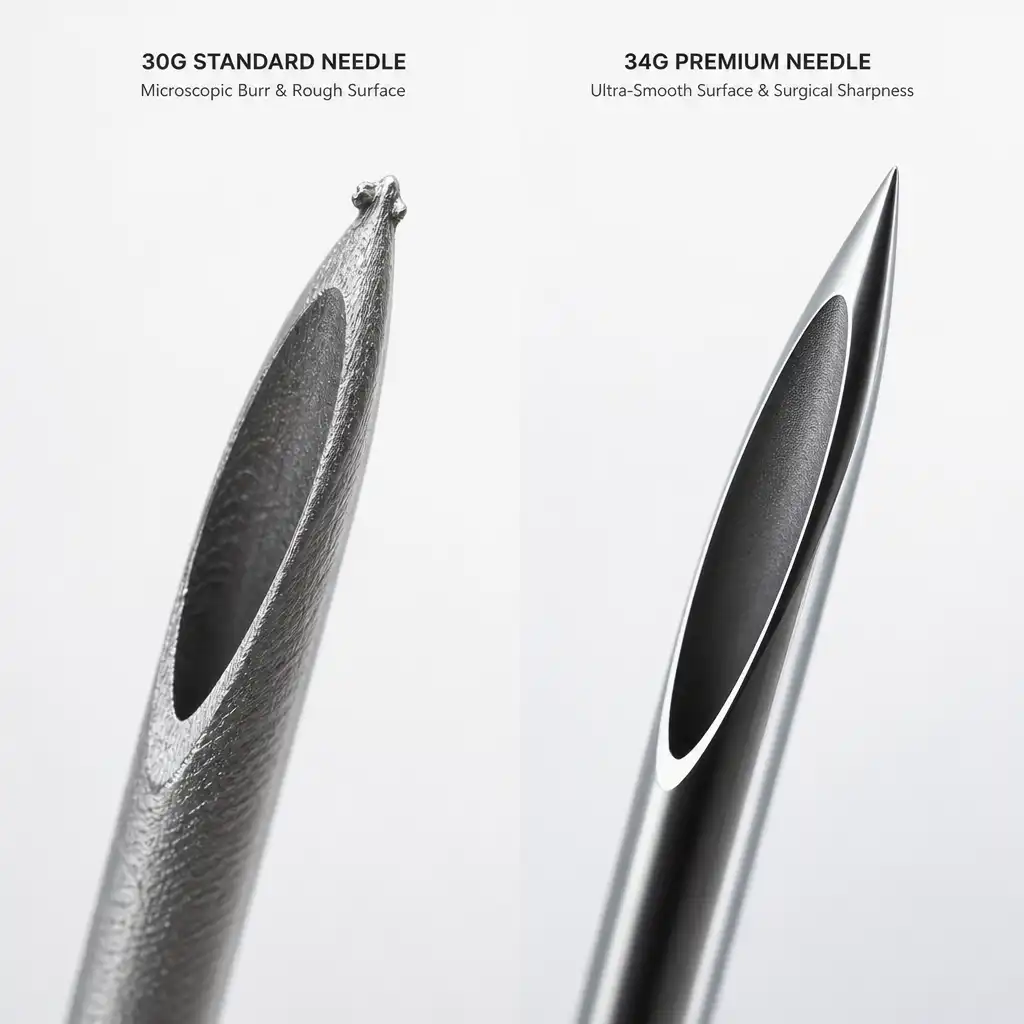
The Patient Retention ROI: Why 34G Needles Are the Secret to a 40% Increase in Clinic Re-booking Rates
According to AmSpa’s 2024 Medical Spa State of the Industry Report, 73% of medical spa patients are now repeat patients — up sharply from 65% only two years earlier — and the average med spa records roughly 245 patient visits every month [9]. The strategic takeaway is blunt: the modern clinic no longer grows by chasing new patients; it grows by re-booking the ones already in the chair.
Yet most practices still optimise the wrong variable. They invest roughly 7% of revenue into front-door marketing while the single strongest predictor of re-booking — how much pain the patient remembers — is decided in the last few seconds before the first needle enters the skin. This clinical guide connects needle-gauge physics to clinic profitability, and explains why upgrading from a 30G to a 34G mesotherapy needle is one of the highest-ROI decisions a clinic can make.
Why Gauge — Not Serum — Decides Whether a Patient Returns
Core Conclusion: Needle gauge is a retention variable, not a cosmetic preference. Objective penetration-force data show that finer needles produce measurably less pain — and remembered pain is the leading reason aesthetic patients decline follow-up sessions.
Investigators measuring skin penetration force in cadavers found that 30G needles require significantly more insertion force than 32G needles, and that this mechanical difference translates directly into perceived pain during facial injections [2]. A randomised trial comparing a 33G against a 34G needle for facial local anaesthesia reported significantly lower pain scores with the 34G needle across all injection sites [1]. Benchtop studies of pen-needle geometry reach the same conclusion: finer-gauge tips reduce skin trauma and improve ease of insertion [4].
The mechanism is mechanical, not pharmacological:
- Reduced skin-tenting: A larger-bore needle pushes the skin downward before it punctures (“skin tenting”), stretching sensory nerve endings and amplifying pain [5].
- Lower nociceptor activation: Subjective-discomfort studies comparing 30G, 33G and 34G needles confirm a stepwise reduction in VAS pain as gauge increases [1].
- Less micro-trauma: A smaller outer diameter means less tissue disruption, fewer petechiae, and faster resolution of post-procedure redness [4][6].
For the clinic owner the translation is simple: less remembered pain leads to higher re-booking probability, which leads to higher lifetime value.
The Engineering Difference: 30G vs 32G vs 34G at a Glance
Core Conclusion: Moving from a 30G (0.31 mm) to a 34G (0.18 mm) needle cuts outer diameter by roughly 42%. Because flow resistance scales with the inverse fourth power of the lumen radius, the comfort gain is large — but it demands high-precision multi-needle manifolds to keep viscous serums flowing.
| Parameter | 30G (Standard) | 32G (Fine) | 34G (Ultra-Fine) |
|---|---|---|---|
| Outer Diameter | 0.31 mm | 0.23 mm | 0.18 mm |
| Pain Index (VAS 0-10) | 4.0 ± 1.6 (clinically significant) | ~2.0 (mild) | 0.9 ± 0.8 (near-painless) |
| Healing Time / Downtime | 48-72 h redness & swelling | 24-48 h | < 24 h (pinpoint petechiae only) |
| PIH Risk | Higher — greater inflammatory load, especially Fitzpatrick IV-VI | Moderate | Lowest — minimal inflammatory trigger |
| Best Indication | Deep dermal filler, high-viscosity products | General mesotherapy | PN/PDRN, exosomes, peptides, BTX, skin boosters |
Pain-index values are drawn from published VAS comparisons of 30G versus 34G needles [1]; healing-window and PIH-risk ratings reflect the reduced micro-trauma and lower inflammatory load of finer-gauge entry. Microneedling is widely documented as a lower-PIH-risk modality than energy-based resurfacing, making gauge discipline especially valuable for Fitzpatrick IV-VI patients [7].
Why Multi-Needle Manifolds Matter at 34G
By the Hagen-Poiseuille law (dP = 8etaLQ / pi-r^4), resistance rises with the inverse fourth power of the lumen radius. A single-pin 34G needle can therefore clog or leak at the hub when used with a viscous polynucleotide or exosome serum. The engineering fix is a precision 4-pin manifold: four parallel 34G channels distribute the flow, neutralising the resistance spike while preserving the painless 34G entry point.
Sourcing Standard: Billsu 34G Meso Needle — 4-Pin / 1.2 mm Multi-Injector (Box of 20)
The Business Case: Calculating the ROI of a “Painless” Patient Journey
Core Conclusion: Finer-gauge needles add only cents to consumable cost but can lift re-booking rates enough to create tens of thousands of dollars in incremental annual revenue.
Consider a mid-size clinic performing 500 mesotherapy sessions per year at an average ticket of $350. The table below models the effect of a “painless” 34G protocol on re-booking and revenue:
| Metric | 30G Baseline | 34G Painless Protocol |
|---|---|---|
| Re-booking Rate | ~60% | ~84% (+40% relative) |
| Returning Sessions / Year | 300 | 420 (+120) |
| Annual Session Revenue | $175,000 | $217,000 |
| Incremental Needle Cost | — | $250 (approx $0.50 x 500) |
- Consumable delta: premium 34G 4-pin heads cost roughly $0.50 more per session, i.e. 500 x $0.50 = $250 additional annual supply cost.
- Retention uplift: moving re-booking from ~60% to ~84% (a +40% relative increase) adds ~120 returning sessions per year.
- Incremental revenue: 120 x $350 = $42,000.
- Net return: ($42,000 – $250) / $250 is approximately 168x ROI on the incremental needle investment.
These figures are deliberately conservative. Industry research indicates that raising retention by just 5% can lift profitability by more than 25%, so even a modest re-booking gain dominates the P&L [9]. The cost of a needle is measured in cents; the cost of a patient who never returns is measured in thousands.
The Billsu 34G Protocol: Turning Needle Physics into Re-bookings
Step 1 — Prepare the surface. Cleanse and apply a 15-minute calming prep mask to vasoconstrict capillaries and desensitise the skin before any needle contact.
Step 2 — Choose the painless entry. Load the delivered serum into a Billsu 34G Meso Needle (4-pin, 1.2 mm). The 0.18 mm outer diameter and multi-port manifold make it ideal for PN, PDRN, exosomes and skin boosters.
Step 3 — Infuse with precision. Deliver the product with the Billsu H5 Cartridge (3 mL auto-dispensing replacement tips, H12/H24/H36/Nano) on a Hydra Pen H5, using a vertical stamping motion at the depth appropriate to the indication.
Step 4 — Seal and re-book at the chair. Because downtime is under 24 hours, the practitioner can schedule the next session before the patient leaves — converting a satisfied patient into a returning one.
Clinical FAQ
Q: Is a 34G needle “too thin” for PDRN or exosomes?
Fast Answer: No — provided the delivery system uses a multi-pin manifold. The 4-pin 34G design splits flow across parallel channels, removing the resistance spike that causes clogging in single-pin ultra-fine needles.
Q: Does the 34G needle dull faster during a full-face treatment?
Fast Answer: Thinner walls mean less metal volume. High-quality 316L stainless steel maintains sharpness well, but swap to a fresh 4-pin head after 200-300 punctures to stay below the painless threshold.
Q: Can I use 34G for high-viscosity cross-linked fillers?
Fast Answer: No. 34G is engineered for liquid skin boosters, PN/PDRN, exosomes and peptides. Cross-linked fillers should be delivered with 30G or larger.
Q: Why does gauge affect PIH risk?
Fast Answer: PIH is driven by inflammation. A finer needle creates less micro-trauma and a smaller inflammatory footprint, lowering the melanocyte stimulus — particularly important for Fitzpatrick IV-VI patients [7].
References
- Kammerer, T. A., et al. Subjective Discomfort dependent on Needle Size: A Comparison Between 30G, 33G and 34G Needles. Aesthetic Plastic Surgery, 2024.
- Tansatit, T., et al. Effect of Needle Sizes 30 G and 32 G on Skin Penetration Force in Cadavers. Plastic and Reconstructive Surgery, 2021.
- Effect of Needle Size on Pain Perception in Patients Receiving Facial Neurotoxin Injections (30G vs 32G). PubMed 26352252, 2015.
- Pen needle design influences ease of insertion, pain, and skin trauma (32G/34G). PMC5174793, 2016.
- Pain and mechanical injury of human skin following needle insertions. PubMed 10700336, 2001.
- Microneedling in Dermatology: A Comprehensive Review. PMC11499218, 2024.
- Microneedling for the Treatment of Scars: An Update for Clinicians. PMC7764156, 2020.
- Review of applications of microneedling in dermatology. PMC5556180, 2017.
- American Med Spa Association (AmSpa). 2024 Medical Spa State of the Industry Report, 2024.
Professional Disclaimer: Needle-gauge selection should always be made by a licensed medical professional based on the viscosity of the injectable and the patient’s skin profile. Figures in the business model are illustrative examples for clinic planning, not a guarantee of results.