$75 with free shipping, buy now!

True Needle Depth: Why Most Microneedling Pens Fail Results

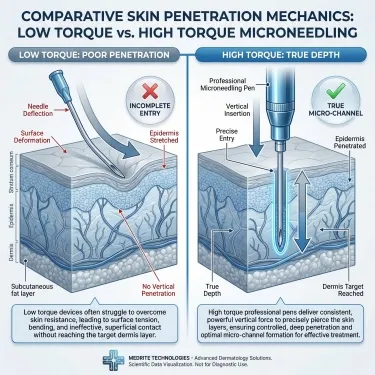
In the aesthetic industry, we are obsessed with numbers. We talk about “18,000 RPM” and “2.5mm depth” as if they are the ultimate indicators of a device’s power.
But here is the Big Truth: Most of those numbers are a lie.
If you’ve ever performed a treatment at 1.5mm and wondered why the skin response looked more like a light scratch than deep remodeling, you’ve experienced the “Torque Gap.” Here is the hard science behind why your equipment’s motor matters more than its dial settings.
1. The Physics of “Puncture Resistance”
Skin isn’t a piece of paper; it’s a highly elastic, multi-layered shield. To pierce the stratum corneum and reach the dermis, a needle must overcome Puncture Resistance Force.
The Data: Research in biomechanics shows that human skin requires between 0.5N to 3.0N of force to be successfully breached.
The Problem: Most consumer-grade or low-cost microneedling pens use motors with high RPM (speed) but low Torque (power). When the needle hits the skin, the resistance causes the motor to “stall” or slow down. Instead of piercing the tissue, the needle simply pushes the skin down, creating a shallow indentation.
The Result: You dial in 1.5mm, but you only achieve 0.5mm of actual penetration. This is why “cheap” pens fail to treat deep acne scars or stretch marks—they simply don’t have the muscle to get there.
2. Horizontal Vibration: The “Shredding” Effect
A professional microneedling treatment should create a vertical micro-channel. It should be a clean “in-and-out” motion.
The Reality: In unstable devices, the needle cartridge has “play” or horizontal wobble. Even a 0.2mm lateral movement at 100 hits per second turns your needle into a tiny saw blade.
The Consequence:
– Micro-tearing: Instead of clean holes, you are creating jagged tears.
– Extended Downtime: This is why some patients stay red for 5 days instead of 24 hours.
– Scarring Risk: Excessive lateral trauma can trigger post-inflammatory hyperpigmentation (PIH).
The Solution: Professional-grade pens like the Professional Microneedling Pen use stabilized internal guide rails. By keeping the horizontal deviation to <0.05mm, we ensure the injury is controlled, precise, and heals rapidly.
3. Empty RPMs vs. Loaded Stability
As soon as those needles touch the patient’s forehead or jawline, that speed drops. A high-quality device is engineered to maintain Loaded Stability. It maintains its frequency regardless of skin density or scar tissue resistance.
Summary: Invest in Physics, Not Just Plastic
When choosing equipment for your clinic, ask about the motor’s torque and the stability of the drive shaft.
If a device can’t maintain its depth under pressure, it’s just a vibrating toy. For real clinical results—especially in scar revision and deep collagen induction—you need a tool that respects the laws of physics.
—
Stop guessing your treatment depths. Upgrade to a Professional Microneedling Pen engineered for true dermal penetration.