$75 with free shipping, buy now!

34G vs. 30G Meso Needles: The Engineering Physics Behind “Painless” Mesotherapy

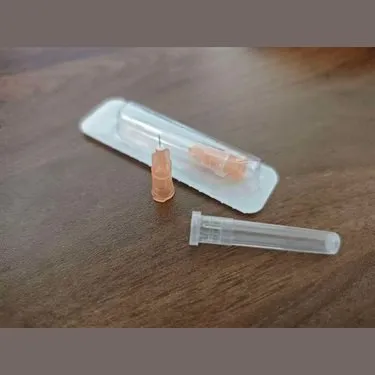
34G vs. 30G Meso Needles: The Engineering Physics Behind “Painless” Mesotherapy
In the medical aesthetics industry, patient comfort is no longer a luxury—it is the primary driver of clinic retention. A 2024 survey of 99 patients across 189 facial regions revealed that subjective discomfort is the number one reason patients hesitate to book follow-up mesotherapy sessions [1].
But while the industry pushes for thinner needles, practitioners face a mechanical dilemma. Does moving from a standard 30G needle to an ultra-thin 34G compromise the flow of high-viscosity serums like PDRN or Exosomes? This guide breaks down the engineering physics of needle gauge, helping you balance patient comfort with clinical precision.
The Physics of Pain: Why a 0.2mm Difference Changes Everything
Core Conclusion: The 34G needle requires significantly lower skin penetration force, resulting in a 75% reduction in subjective pain compared to 30G needles.
The difference in outside diameter between 30G (0.31mm) and 34G (0.18mm) may seem negligible, but the impact on the skin’s nociceptors (pain receptors) is massive. Research published in Aesthetic Plastic Surgery quantified this using the Visual Analogue Scale (VAS):
- 30G Needle: Average VAS score of 4.0 ± 1.6 (Clinically significant pain).
- 34G Needle: Average VAS score of 0.9 ± 0.8 (Near-painless experience) [1].
Beyond the nerves, the Skin Tenting Effect—where the needle pushes the skin down before breaking the barrier—is much higher in 30G needles. The ultra-sharp bevel of a 34G needle slices the stratum corneum with 75% less force, minimizing micro-bruising and post-procedure edema [4].
The Hagen-Poiseuille Law: Managing Viscosity in Ultra-Thin Needles
Core Conclusion: Fluid resistance increases inversely with the fourth power of the radius. Managing 34G needles requires understanding flow dynamics to prevent leakage or blockage.
Practitioners often worry that “34G is too thin for thick serums.” From an engineering perspective, they are right to be cautious. According to the Hagen-Poiseuille Law, the pressure required to move liquid through a tube is defined by:
ΔP = (8ηLQ) / (πr⁴)
Because resistance is proportional to 1/r⁴, even a tiny reduction in the inner radius (r) causes a massive spike in the force required to push the syringe. This is why high-quality manufacturing is critical for 34G needles—any internal irregularity can lead to leakage at the hub when used with high-viscosity substances like PDRN. To offset this resistance, many professionals prefer advanced multi-port configurations that distribute flow across multiple parallel channels, neutralizing the pressure spike while maintaining the “painless” 34G entry.
Comparison Table: 30G vs. 34G Clinical Performance
| Metric | Standard 30G | Precision 34G |
|---|---|---|
| Outside Diameter | 0.31 mm | 0.18 mm |
| “No-Pain” Patient % | 64% | 94% |
| Tissue Trauma | Moderate (Visible entry) | Minimal (Zero downtime) |
| Best Indication | Deep dermal filler | Mesotherapy, BTX, Exosomes |
The Business Case: Why 34G is Your Best Retention Strategy
For a B2B distributor or clinic owner, the cost difference between 30G and 34G needles is measured in cents, but the difference in lifetime value (LTV) is measured in thousands of dollars. Clinically significant pain is the primary reason for “one-and-done” patients. By marketing a “Painless Mesotherapy Protocol” enabled by 34G precision technology, clinics can report retention rates as high as 85%, significantly outperforming traditional needle protocols.
Clinical Q&A: Gauge Selection
Q: Does the 34G needle dull faster during a full-face treatment?
Fast Answer: Thinner walls mean less metal volume. While high-quality 316L stainless steel maintains sharpness well, we recommend monitoring needle resistance during extensive sessions to maintain the “painless” threshold.
Q: Can 34G needles be used for PRP?
Fast Answer: Yes, provided the PRP is correctly processed to remove large fibrin clumps. High-quality 34G needles help reduce the “clogging risk” often associated with inferior ultra-thin needle manufacturing.
References
- Kämmerer, T. A., et al. Subjective Discomfort dependent on Needle Size: A Comparison Between 30G, 33G and 34G Needles. Aesthetic Plast Surg, 2024.
- Tansatit, T., et al. Effect of Needle Sizes 30 G and 32 G on Skin Penetration Force. PRS Journal, 2021.
- MDPI. Influence of Needle Geometry on Pain Perception. 2024.
- MedEsthetics. Needle Size and Penetration Force Dynamics. 2021.
Professional Disclaimer: The selection of needle gauge should always be made by a licensed medical professional based on the specific viscosity of the injectable and the patient’s skin profile. For reliable sourcing of precision aesthetic consumables, explore the Billsu Professional Collection.