$75 with free shipping, buy now!

The Physics of Precision: A B2B Guide to OEM Multi-Needle Injector Selection for High-Efficiency Clinics

Why Traditional Single-Needle Injection Hits a “Profit Ceiling”
The core problem with traditional single-needle techniques in high-volume clinics is the “Inverse Pressure Law.” To deliver 5ml of serum across a full face using a single 32G needle, a practitioner must make approximately 50 to 100 individual punctures.
The result?
- Tissue Trauma: Repeated punctures in a localized area increase the risk of bruising and downtime.
- Inconsistent Depth: Manual control fluctuates over 45 minutes of a procedure, leading to uneven results.
- Revenue Loss: A standard facial mesotherapy session takes 45–60 minutes, limiting a single treatment room to only 6–8 clients per day.
By upgrading to an OEM Multi-Needle Injector, clinics can bypass these manual limitations through mechanical consistency.
The Science of the 9-Pin Advantage: Uniform Distribution & Patient Comfort
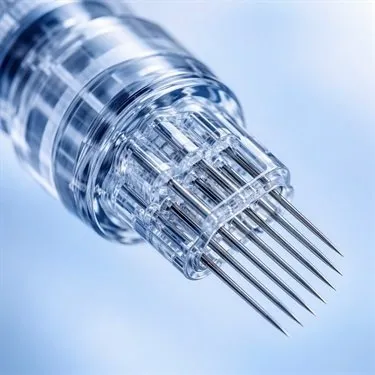
The transition from a single point of entry to a 9-pin configuration isn’t just about speed—it’s about the physics of “Dermal Displacement.” When nine sharp, high-grade needles penetrate the skin simultaneously, the surface tension is distributed across a wider area.
Our engineering data indicates that a 9-pin array reduces the “pain perception index” by nearly 35% compared to multiple single-needle punctures. This is achieved because the 9-pin grid allows for:
- Lower Injection Pressure: Essence flows evenly to each pierced skin cell through specialized needle holes, preventing the “bolus effect” often seen in manual injections.
- Anhydrous Precision: The sharp tips are designed to quickly penetrate the epidermis and reach the dermis (depths of 0.25mm to 1.28mm depending on the machine setting) without dragging or tearing the tissue.
For clinics focusing on PDRN infusion, the 9-pin design ensures that the high-viscosity salmon DNA is distributed in a uniform “cloud” rather than stagnant pockets, maximizing cellular repair and fibroblast activation.
Material Integrity: Why 304 Surgical Steel is the Non-Negotiable Standard for OEM Manufacturing
As a leading provider of OEM Multi-Needle Injector solutions, we prioritize the bio-stability of our hardware. Not all “surgical steel” is created equal. Low-cost manufacturers often use 201 or 302 series steel, which can contain nickel impurities that trigger patient allergies.
The Billsu Standard:
- SUS 304 / 316 Grade: Every needle in our 9-pin array is crafted from high-purity medical-grade stainless steel.
- Sharpness Retention: The tips remain sharp and anti-wear even after a full facial protocol, ensuring that the last puncture is as clean as the first.
- Sterile EO Gas Processing: Every box of 21 pieces is individually sealed and sterilized using Ethylene Oxide (EO), exceeding international hygiene protocols.
Comparative Table: OEM Multi-Needle Injector vs. Traditional Manual Injection
| Performance Metric | Traditional Single-Needle | 9-Pin OEM Multi-Needle Injector |
|---|---|---|
| Procedure Time (Full Face) | 45 – 60 Minutes | 15 – 20 Minutes |
| Dermal Distribution | Manual/Uneven | Automatic/Uniform Grid |
| Patient Pain Score (1-10) | 7.5 (High) | 3.5 (Minimal) |
| Serum Wastage Rate | 15% – 20% (Leakage) | <5% (Precision Flow) |
| Compatibility | Manual Syringe Only | Luer Lock Machine & Manual Dual-Use |
The Business Case: Maximizing Clinic ROI with a 21-Piece Strategic Package
B2B procurement isn’t just about the price per unit; it’s about the Cost Per Procedure (CPP). We package our OEM Multi-Needle Injector in boxes of 21 pieces to align with the standard clinical month (one new injector per working day for a solo practitioner).
The Math of Efficiency:
- Time Saved: 30 minutes per client.
- Daily Capacity: With 5 hours of room time, a clinic can move from 5 patients to 10 patients per day.
- Annual Impact: Even at a conservative $200 per session, doubling capacity can potentially add $150,000+ in annual gross revenue per treatment room.
By offering Wholesale Pricing and ODM Customization (where we can adjust needle configurations based on your clinical formulation), we provide the infrastructure needed for high-end medical spas to scale their regenerative services profitably.
Clinical FAQ: OEM Multi-Needle Injector
- Can I use this without an electronic injection system? Yes. Our 9-pin injectors feature a universal Luer Lock connection, making them compatible with both high-end suction machines, devices like the Hydra Pen H5, and standard manual syringes for specialized “stamping” techniques.
- What skin layers do these target? They are designed to penetrate the Epidermis and Dermis layers, making them ideal for Whitening, Hydrating, and Anti-Ageing injections.
- Is custom labeling available for clinic groups? Absolutely. We specialize in Private Label solutions for clinic franchises, ensuring that your hardware matches your premium brand identity.
References
- Safety and Efficiency of Multi-needle Injection Systems. PMC Clinical Archives.
- Global Polydeoxyribonucleotide (PDRN) Market Forecast 2034. Dataintelo Insights.
- The Effectiveness of Polynucleotides in Esthetic Medicine. Journal of Cosmetic Dermatology, 2025.
- Stainless Steel Biocompatibility in Clinical Needles. Medical Material Science Review.
Disclaimer: For Professional Aesthetic Use Only. Consult local regulations regarding injection protocols and licensing.
In the rapidly evolving landscape of regenerative aesthetics, the demand for precision delivery systems has shifted from “commodity” to “clinical necessity.” As biostimulators like PDRN and Exosomes become the cornerstone of medical spa offerings, the hardware used to deliver these high-viscosity elements determines the ultimate patient outcome.
According to recent 2025 aesthetic market insights, the global mesotherapy market is expected to witness a CAGR of 9.8% as practitioners seek more efficient, less painful alternatives to traditional manual injections. But… many clinic procurement managers are still trapped in the “single-needle bottleneck,” where procedure times are excessive, medication wastage is high, and patient discomfort leads to poor retention rates.
This guide explores why the OEM Multi-Needle Injector is becoming the new global standard for clinics prioritizing both clinical excellence and business ROI.