$75 with free shipping, buy now!

The Clinical Procurement Audit: 5 Metrics for High-Performance 34G Meso Needles

AmSpa’s 2024 industry recap reported that average annual medical spa revenue rose from $1,307,587 to $1,398,833, while 84% of owners expected revenue to increase that year [1]. At that operating scale, a meso needle is not merely a low-cost consumable. Its consistency affects treatment flow, product loss, practitioner confidence, and the experience delivered at every injection point.
But a 34G label and an intact pouch do not prove that a four-pin needle is sharp, leak-resistant, or consistently manufactured. Two visually similar products can behave very differently after connection to a syringe and repeated punctures during one treatment. This guide gives clinic buyers, distributors, and private-label teams a practical 4-pin meso needle quality audit: which manufacturing documents to request, which performance tests matter, and which claims should never be accepted without batch-level evidence.
Why Is “34G” Not Enough to Prove Meso Needle Quality?
Core conclusion: Gauge describes outside diameter; it does not verify bevel geometry, penetration force, tube stiffness, hub bonding, manifold sealing, lubrication, sterility, or batch consistency.
The clinical value of a fine needle is real. A 2024 prospective study included 99 patients and 189 treated facial regions. Immediately after treatment, average discomfort scores for the forehead were 3.9 with 30G, 2.7 with 33G, and 1.7 with 34G. In the glabella, the corresponding scores were 4.3, 2.7, and 1.6; the differences were statistically significant [9].
That evidence supports the comfort potential of 34G needles, but it does not mean every 34G product performs equally. The finished needle still depends on how accurately the tube is formed, ground, cleaned, bonded, assembled, lubricated, sterilized, and sealed. A buyer therefore needs evidence for both the raw component and the completed four-pin device.
| What the label tells you | What it does not tell you | Evidence to request |
|---|---|---|
| 34G outside-diameter designation | Initial penetration force and bevel consistency | Finished-needle penetration-force report |
| 1.2 mm nominal length | Four-needle length alignment and perpendicularity | Dimensional inspection record with tolerances |
| Sterile symbol on packaging | Validated sterilization cycle and sterile-barrier integrity | Sterilization validation, lot record, and packaging validation |
The practical rule is simple: treat gauge as a specification, not as proof of finished-device quality.
Which Manufacturing Credentials Should a Buyer Verify Before Ordering?
Core conclusion: A credible supplier should connect its quality-system credentials to the legal manufacturer, production address, device scope, and batch records. A certificate logo by itself is not enough.
ISO 13485 defines quality-management-system requirements for organizations involved in the design and production of medical devices. ISO notes that third-party certification can demonstrate conformity, but ISO itself does not certify companies [2]. In the United States, FDA’s Quality Management System Regulation became effective on February 2, 2026 and incorporates ISO 13485:2016 as its foundational framework for medical-device quality systems [3].
Buyers should also understand what an FDA database entry does not prove. FDA states that establishment registration and device listing do not denote approval, clearance, or authorization of either the facility or its devices [4]. If a supplier uses the phrase “FDA registered,” ask for the establishment record, device listing, applicable classification, and any product-specific clearance or exemption rationale. Do not accept registration as a substitute for product evidence.
Six documents to request from a 4-pin meso needle manufacturer
- ISO 13485 certificate: Verify the certificate number, issuing certification body, validity dates, production-site address, and scope covering the relevant finished device.
- Market-specific regulatory evidence: Request the device listing, clearance, registration, declaration, or exemption evidence required in the market where the needle will be sold.
- Device specification and drawing: Confirm gauge, needle length, four-pin alignment tolerances, materials, connector type, and intended use.
- Sterilization and packaging validation: Confirm the sterilization method, validated cycle, residual controls where applicable, sterile-barrier validation, lot code, and expiry basis.
- Finished-product performance reports: Ask for penetration force, tube-to-hub bond, flow, leakage, connector, and visual-inspection data on the assembled device.
- Traceability and change control: Require lot-level records, complaint handling, nonconformance controls, and written notification before changes to steel tubing, lubricant, adhesive, mould, sterilization, or packaging.
A manufacturer that cannot connect these records to the exact product and manufacturing site has not completed the audit, regardless of how polished its catalogue looks.
How Can Buyers Verify That a Four-Pin Needle Is Actually Sharp?
Core conclusion: Sharpness should be measured as penetration-force performance, not judged from a photograph or described with adjectives such as “ultra sharp.”
ISO 7864:2016 specifies requirements and test methods for sterile, single-use hypodermic needles, including finished-needle performance [5]. ISO 9626:2016 separately covers rigid stainless-steel needle tubing from 10G to 34G and specifies dimensions and mechanical properties of the tubing component [6]. The distinction matters: compliant tubing is necessary, but the finished bevel and four-pin assembly still require their own validation.
A useful supplier report should state the test medium, insertion speed, sample size, conditioning, acceptance limit, mean result, variability, and lot identification. Buyers should ask for force curves or raw data rather than a single “pass” statement. A low average with high unit-to-unit variation can still produce a poor treatment experience.
A practical incoming-inspection sequence
- Package and identity check: Match lot number, expiry, gauge, length, sterilization marking, and connector description to the purchase specification.
- Magnified visual inspection: Check all four bevels for burrs, hooks, blocked lumens, uneven grinding, contamination, bent tubes, and inconsistent projection length.
- Baseline penetration test: Use a validated synthetic substrate and controlled test speed to compare initial peak force across samples from the same lot.
- Alignment check: Confirm that all four needles contact the test plane consistently; one proud or recessed needle changes dose distribution and force balance.
- Trend review: Compare the new lot against the approved reference lot, not only against a wide pass/fail ceiling.
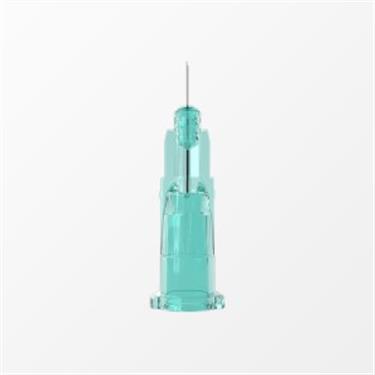
Billsu’s 34G, 1.2 mm four-pin meso needle provides the dimensional format buyers may use as the starting point for this audit; procurement approval should still be based on the documents and batch-level performance evidence required by the buyer’s market and quality system.
Why Do Some Four-Pin Meso Needles Leak Even When the Luer Feels Tight?
Core conclusion: A secure syringe connection verifies only one part of the fluid path. A four-pin system can also leak at the connector, manifold, adhesive interface, needle-to-hub bond, or an obstructed channel.
ISO 80369-7:2021 covers dimensions and functional performance for Luer connectors used in hypodermic and intravascular applications [7]. Its performance framework includes fluid leakage, sub-atmospheric air leakage, separation forces, unscrewing, overriding, and stress cracking. However, a compliant primary Luer connection does not by itself validate the custom internal manifold that divides flow into four needles.
| Possible failure point | What the practitioner may notice | Procurement evidence |
|---|---|---|
| Luer interface | Fluid around the syringe connection or loosening under use | ISO 80369-7 dimensional and functional test evidence |
| Four-way manifold | Wet housing, unequal output, or loss before the tips | Positive-pressure finished-device leakage test |
| Needle-to-hub bond | Movement, seepage, or tube separation | Bond-strength and leak-test report |
| One blocked lumen | Three active points and one weak or absent stream | Four-channel flow-balance test with stated tolerance |
For incoming inspection, use a qualified, documented test method and a safe test fluid outside clinical use. Record whether leakage appears at the connector, housing, bond, or tip. A device should never be released for patient use after destructive or nonsterile testing.
Can a Meso Needle Stay Sharp Through Repeated Punctures in One Treatment?
Core conclusion: No responsible supplier should promise that a needle “never becomes dull.” The defensible requirement is controlled penetration-force change and acceptable tip geometry across the validated number of punctures within one single-patient procedure.
Repeated-puncture research shows why this must be tested. A 2018 laboratory study tested 40 single-use hypodermic needles across four gauges. Peak penetration force began increasing after the first use, and the needles reached maximum bluntness within approximately two to five punctures. Depending on gauge, the mean force increase from the first puncture to the plateau ranged from 33.1% to 64.7% [8]. These were 14G–20G needles tested on rehydrated bovine leather, not 34G facial meso needles, so the percentages must not be transferred directly to a four-pin product. The study nevertheless demonstrates why “stays sharp” requires product-specific evidence rather than assumption.
An electron-microscopy study of facial filler needles also found that repeated injections produced progressive needle-tip deformation and could increase the force required for dermal penetration [10]. The practical procurement response is not to claim zero wear. It is to define an intended within-session puncture profile and validate it.
What a repeat-puncture validation report should show
- Initial peak penetration force for every tested needle head.
- Peak force after defined puncture intervals that represent the intended single-patient procedure.
- Percentage change from baseline and the approved acceptance limit.
- Microscope or scanning-electron-microscope images before and after testing.
- Evidence of no hooks, burrs, bending, lumen blockage, tube movement, or manifold leakage.
- Separate results for each production lot, or a validated sampling plan tied to routine quality control.
This validation never authorizes cross-patient reuse. A sterile single-use meso needle must be used for one patient and discarded after the procedure. It should be replaced sooner if resistance rises, a tip contacts a hard surface, a tube bends, flow becomes unequal, the connection leaks, or sterility is compromised.
What Should a Purchase Specification Include Before Mass Production?
Core conclusion: Convert marketing phrases into measurable acceptance criteria before paying a deposit. If “sharp,” “leak-free,” and “durable” are not defined in the purchase specification, they are not enforceable quality requirements.
| Marketing claim | Measurable procurement requirement | Release evidence |
|---|---|---|
| Made by a compliant factory | Verified QMS, legal manufacturer, site, scope, and market authorization path | Current certificates and regulatory records |
| Ultra sharp | Defined initial penetration-force limit and lot variability limit | Force curves and statistical summary |
| No leakage | Connector plus finished four-way manifold pressure test | Test method, pressure, hold time, sample size, and results |
| Does not become dull | Maximum permitted force increase over the validated single-session puncture count | Repeat-puncture curves and post-test microscopy |
| Consistent delivery | Defined flow-balance tolerance across all four lumens | Four-channel output test by lot |
Approve a golden sample only after document review and independent performance checks. Then make the approved specification, reference sample, test method, change-notification requirement, and rejection process part of the supplier agreement.
The Business Case: Why Needle Quality Is a Revenue-Control Decision
Core conclusion: Procurement savings matter only if the needle preserves treatment consistency. In a sector where the average med spa reported $1,398,833 in annual revenue, preventing interruptions, leakage, rework, and client discomfort protects a much larger operating system than the unit price of the needle [1].
The correct cost comparison is not “price per needle.” It is cost per completed, uninterrupted treatment. A low quotation can become expensive when a clinic must replace a leaking head, discard serum, pause a procedure, document a complaint, or rebuild client confidence.
| Cost layer | Low-price-only sourcing | Evidence-based sourcing |
|---|---|---|
| Consumable purchase | Lowest quoted unit cost | Qualified unit cost with traceability |
| Treatment continuity | Higher uncertainty if force or flow varies | Controlled through agreed acceptance tests |
| Product loss | Leak and blocked-channel risk is unknown | Leakage and flow balance are verified |
| Complaint investigation | Weak lot evidence and slow root-cause analysis | Lot records support containment and corrective action |
When comparing quotations, add the clinic’s actual serum cost, practitioner minutes, replacement rate, interrupted-session rate, and complaint-handling cost. This produces a defensible total-cost model without inventing universal savings claims.
When Should a Buyer Reject a Meso Needle Lot?
Core conclusion: Reject or quarantine a lot when identity, sterile-barrier integrity, traceability, dimensional conformity, penetration force, flow balance, connector security, or leakage falls outside the approved specification.
- The certificate scope or manufacturing address does not match the supplier’s claim.
- Lot and expiry information are missing, inconsistent, or not traceable to production records.
- Packaging has punctures, weak seals, contamination, or unreadable labels.
- One or more needle tips show burrs, hooks, bending, blocked lumens, or unequal length.
- Initial penetration force or lot variability exceeds the approved reference range.
- Repeated-puncture force rises beyond the validated acceptance limit.
- Fluid appears at the Luer connection, manifold, adhesive interface, or tube-to-hub bond.
- Output across the four lumens is visibly or measurably unbalanced.
For clinics and distributors evaluating pack sizes, the Billsu four-pin multi-injector needle range includes 20-piece and 30-piece configurations. The same audit criteria should be applied before routine clinical release, regardless of brand or order volume.
Frequently Asked Questions About 4-Pin Meso Needle Quality
Is ISO 13485 certification enough to approve a meso needle supplier?
No. ISO 13485 supports confidence in the manufacturer’s quality-management system, but buyers must still verify certificate scope, manufacturing site, market-specific regulatory status, sterility, packaging, and finished-product performance.
Does FDA registration mean a 4-pin meso needle is FDA approved?
No. FDA explicitly states that registration and listing do not denote approval, clearance, or authorization. Ask for the applicable product-specific regulatory evidence and verify it independently.
How should meso needle sharpness be compared?
Compare controlled penetration-force data from multiple units and lots, using the same substrate, insertion speed, conditioning, and test method. Review both the average and variability, then compare results with an approved reference lot.
Can a single-use four-pin needle be used for multiple patients if it still looks sharp?
No. Single-use means one patient and one procedure. Apparent sharpness does not preserve sterility, prevent cross-contamination, or prove that the needle and hub remain mechanically safe.
What proves that a four-pin needle will not leak?
Request connector testing plus a pressure-based leakage test on the complete four-pin assembly. The report should identify test pressure, hold time, sample size, acceptance criteria, lot, and whether all four channels delivered within the approved balance tolerance.
References
- American Med Spa Association. 2024 Medical Spa State of the Industry Executive Report Recap. 2024.
- International Organization for Standardization. ISO 13485 — Medical Devices Quality Management Systems. ISO.
- U.S. Food and Drug Administration. Quality Management System Regulation (QMSR). Effective February 2, 2026.
- U.S. Food and Drug Administration. Important Reminders About Registration and Listing. FDA.
- International Organization for Standardization. ISO 7864:2016 — Sterile Hypodermic Needles for Single Use. 2016.
- International Organization for Standardization. ISO 9626:2016 — Stainless Steel Needle Tubing for the Manufacture of Medical Devices. 2016.
- International Organization for Standardization. ISO 80369-7:2021 — Connectors for Intravascular or Hypodermic Applications. 2021.
- Majcher K, Eichorn D, Waldner C, et al. Assessing the Sharpness of Hypodermic Needles After Repeated Use. Canadian Veterinary Journal, 2018.
- Kämmerer TA, Bertlich R, Hartmann D, et al. Subjective Discomfort During Botulinumtoxin Injections Dependent on Injection Site and Needle Size: A Comparison Between 30G, 33G and 34G Needles. Aesthetic Plastic Surgery, 2024.
- Piñeiro J, Green JB, et al. Deformation of Needle Tips During Facial Soft Tissue Filler Injections: An Electron-Microscopic Study. Aesthetic Surgery Journal, 2021.
Professional use only. This article is a procurement and quality-management guide, not a substitute for local regulatory advice, device instructions for use, clinical training, or a manufacturer’s validated release procedures. Single-use needles must never be shared between patients.