$75 with free shipping, buy now!

PDRN Microneedling Aftercare: What to Apply, What to Avoid, and How Clinics Can Standardize the First 72 Hours

“PDRN microneedling” is moving from a niche phrase into a common patient question. In Semrush’s United States database, the query shows a monthly volume of 720, a keyword difficulty of 4%, and a visibly rising 12-month trend as measured on November 10, 2026. But search growth creates a clinical communication problem: a popular phrase can make different products, delivery routes, and evidence levels sound interchangeable.
This guide answers the practical question clinics actually face: what should happen after a PDRN microneedling session, and how can a team choose products and consumables without turning a trend into an unsupported promise? The short answer is to separate the procedure, the product route, and the aftercare plan. PDRN research includes laboratory, animal, injectable, and topical contexts; those results cannot automatically be transferred to every serum used after microneedling.
What does PDRN microneedling actually mean?
PDRN stands for polydeoxyribonucleotide, a DNA-derived material studied for tissue repair and inflammatory regulation. A 2020 review describes mechanisms involving adenosine A2A receptor signaling and the nucleotide salvage pathway, while also showing that the evidence comes from several different models and indications. That is useful scientific background, but it is not the same as proof that every cosmetic serum produces the same result after a needling session.
In practice, the phrase “PDRN microneedling” may refer to at least three different workflows:
| Workflow | What reaches the skin | Evidence question to ask |
|---|---|---|
| Microneedling plus a topical serum | A finished topical formulation applied to the treatment area | Is the finished product intended for topical use on recently treated skin? |
| Microneedling followed by a soothing product | A post-procedure formula selected for comfort and barrier support | Does the formula, packaging, and use instruction fit compromised skin? |
| Injectable PN or PDRN treatment | A regulated product delivered by injection under a separate protocol | Is the product authorized and used by a qualified professional for that route? |
These workflows may appear together in marketing content, but they should not be presented as one interchangeable treatment. A 2024 clinical report on PN and hyaluronic acid injections used a defined injectable mixture and a separate topical lidocaine preparation before injection. It is evidence for that specific clinical context, not a license to apply the same products after microneedling.
Should PDRN be applied immediately after microneedling?
There is no universal “yes” or “no” answer that can replace the product’s intended use, instructions for use, and the practitioner’s assessment. Microneedling temporarily changes the skin barrier. The FDA explains that microneedling devices create small punctures and that improper cleaning or use can increase infection risk. That makes the first decision a safety and formulation decision, not a marketing decision.
Before a clinic applies any PDRN-labelled formula after a session, the team should confirm four points:
- Route: Is the product topical, injectable, or intended for another use?
- Finished formulation: Has the actual formula been assessed for the intended post-procedure use, rather than relying on the word “PDRN” alone?
- Instructions: Does the label or IFU describe application to recently treated skin?
- Traceability: Can the clinic record the product name, batch number, expiry date, and patient-facing instructions?
If any answer is unclear, the safest response is to pause and obtain the manufacturer’s documentation or use a product already approved by the clinic’s medical director for that workflow. This is especially important when a supplier markets a cosmetic serum beside injectable PN products. Similar wording does not prove equivalent purity, concentration, sterility, or route of use.
How should a clinic choose a PDRN serum for post-procedure use?
The easiest mistake is to compare products by the front-label ingredient name. A better method is to review the complete product and the complete workflow. A PDRN serum used after microneedling should be evaluated as a finished formula, not as an isolated active ingredient.
| Check | What the team should verify | Why it matters |
|---|---|---|
| Intended use | Topical cosmetic, professional topical, injectable, or another category | Route determines what claims and handling rules are appropriate |
| Ingredient disclosure | Full INCI or regulated ingredient statement, including preservatives and fragrance | Recently treated skin may react differently to unnecessary irritants |
| Packaging | Sealed unit, clean dispensing method, batch code, expiry, storage range | Reduces avoidable handling and supports traceability |
| Instructions | Application area, frequency, restrictions, and professional-use limitations | Prevents staff from inventing a protocol from a marketing claim |
| Evidence match | Human evidence for the same route and similar use context | Separates direct evidence from mechanism or extrapolation |
The PDRN literature is promising but route-sensitive. A review in Advances in Wound Care discusses anti-inflammatory and regenerative mechanisms across experimental and clinical models. A separate 2024 report examined two patients receiving three PN injection sessions at two-week intervals. Those sources support continued research and careful clinical use; they do not establish a universal aftercare formula for every PDRN-labelled topical serum.
For product sourcing, clinics can review the Billsu professional PDRN serum product page as a starting point, then request the exact formula, packaging, use instructions, and batch documentation for the version intended for the target market. The product page should support the conversation, not replace professional review.
What should the first 72 hours look like?
A simple aftercare plan is easier for clients to follow and easier for staff to document. The exact instructions must come from the responsible clinician and the selected product’s documentation, but the communication structure can be standardized.
Immediately after the session
Record the device, cartridge or needle lot, product name, batch number, treatment area, and the products applied. Explain what the client may reasonably notice, such as temporary redness, tightness, or sensitivity, without promising a fixed recovery time. Give the client written instructions and a contact route for unexpected symptoms.
During the first day
Keep the routine simple. Do not introduce multiple new actives simply because the skin feels tight. The client should follow the clinician’s cleansing, sun-protection, and product instructions. If the clinic has not approved a particular serum for post-procedure use, it should not be added as an improvised upgrade.
During days two and three
Use the follow-up message to check symptoms and adherence, not to force a before-and-after claim. Ask whether redness is improving or worsening, whether pain is unusual, and whether the client has developed swelling, discharge, blistering, or another concern that needs professional assessment. The clinic should document the response and escalate according to its medical policy.
This approach also gives the team better before-and-after content. Photographs should use consistent lighting, distance, expression, and timing. A single image cannot prove that PDRN caused an outcome, especially when the session includes microneedling, cleansing, cooling, and other products.
Which sterile consumables belong in the protocol?
PDRN cannot compensate for an uncontrolled delivery system. Microneedling creates micro-injuries, so the cartridge, fluid path, handling process, and surface preparation all belong in the same safety conversation. The FDA advises consumers to discuss benefits and risks and to ask how the device is cleaned and used. A clinic’s written protocol should turn that advice into an auditable routine.
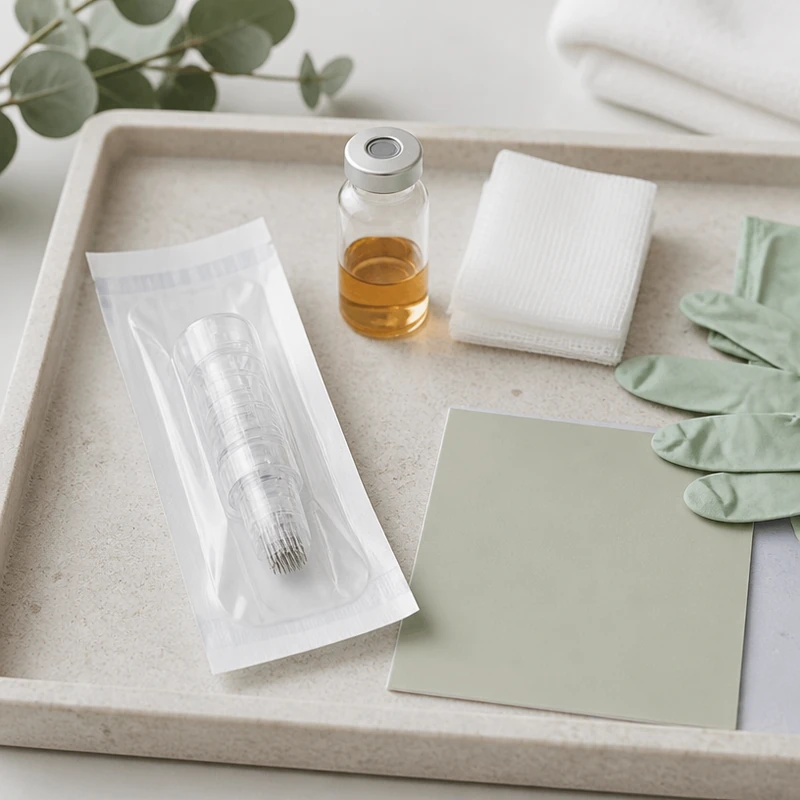
- Open a sealed, single-use cartridge or needle immediately before treatment.
- Record the lot number alongside the product batch used in the session.
- Do not refill, share, or reuse a cartridge or needle.
- Keep the serum pathway and device body consistent with the manufacturer’s instructions.
- Separate unopened stock, opened stock, expired stock, and quarantined stock.
- Document any leak, unusual flow, damaged seal, or unexpected patient response.
For device-specific procurement questions, link the clinical page to the Hydra Pen H5 genuine-versus-generic cartridge guide and the combined microneedling and mesotherapy cartridge guide. These links serve different intent from this article: they explain consumable selection, while this page explains how to connect product route, aftercare, and documentation.
How is this different from a PDRN acne-scar or scalp protocol?
A condition-specific protocol starts with a clinical concern and a treatment plan. Aftercare compatibility starts with the period immediately after skin barrier disruption. That distinction prevents keyword overlap and improves patient communication.
| Page type | Primary question | Best internal-link role |
|---|---|---|
| PDRN microneedling aftercare | What can be applied and documented after the session? | This article as the operational hub |
| Acne-scar PDRN guide | How does a scar-remodelling plan differ by scar concern? | Link for indication-specific background |
| Scalp PN and Hydra Pen H5 guide | How is a scalp workflow organized? | Link for a different treatment area and device context |
| Cartridge procurement guide | How should a clinic evaluate the delivery consumable? | Link for sourcing and quality checks |
For the existing indication-specific content, see the PDRN and microneedling acne-scar guide and the scalp PN and Hydra Pen H5 protocol. This new article should not replace either page; it fills the post-procedure decision gap between treatment completion and follow-up.
The Business Case: standardization is easier to measure than promises
A clinic does not need to claim a specific revenue increase to show the operational value of a standardized PDRN microneedling aftercare plan. Track the numbers you control:
| Metric | Baseline | Target use |
|---|---|---|
| Sessions with complete product and lot records | Measure over the first 30 sessions | Improve documentation completeness |
| Unplanned post-treatment messages | Count by symptom and product batch | Identify unclear instructions or formula issues |
| 48–72 hour follow-up completion | Record the percentage of clients reached | Improve early escalation and client confidence |
| Repeat visits for the same protocol | Compare by treatment area and clinician | Assess consistency, not guaranteed outcomes |
The commercial value comes from fewer improvised decisions, cleaner staff training, and better documentation. After three to four weeks, the clinic can compare these measures with the original baseline. This is a defensible business case because it uses the clinic’s own records rather than an invented conversion rate or an unsupported promise about PDRN results.
FAQ: PDRN microneedling aftercare
Can I use PDRN after microneedling?
Only when the specific finished product is intended for that use and the responsible clinician approves it. Evidence for injectable PN, topical PDRN, and post-procedure products should not be treated as interchangeable.
What is the difference between PDRN microneedling and PN injections?
They use different delivery routes and may involve different products, regulations, and evidence. A PN injection study cannot automatically validate a topical serum applied after microneedling.
Is every PDRN serum suitable for recently treated skin?
No. Review the complete formula, instructions, packaging, batch information, and intended use. The ingredient name alone is not enough to establish compatibility.
What should a clinic record after a PDRN microneedling session?
Record the device and consumable lot, product name and batch, treatment area, products applied, client instructions, and follow-up observations. Use the clinic’s medical policy for escalation of unexpected symptoms.
References
- Jaiswal S, Jawade S. Microneedling in Dermatology: A Comprehensive Review of Applications, Techniques, and Outcomes. Cureus. 2024.
- Alster TS, Graham PM. Microneedling: A Review and Practical Guide. Dermatologic Surgery. 2018;44(3):397–404.
- Colangelo MT, Galli C, Guizzardi S. Polydeoxyribonucleotide Regulation of Inflammation. Advances in Wound Care. 2020;9(10):576–589.
- Kim T-H, Heo S-Y, Oh G-W, et al. Applications of Marine Organism-Derived Polydeoxyribonucleotide: Its Potential in Biomedical Engineering. Marine Drugs. 2021;19(6):296.
- Lee DK, Oh M, Kim MJ, Oh SM. Clinical Effects of Polynucleotide with Hyaluronic Acid Intradermal Injections on Facial Erythema. Skin Research and Technology. 2024;30(9):e70034.
- Yang D, Chen M, Sun Y, et al. Microneedle-Mediated Transdermal Drug Delivery for Treating Diverse Skin Diseases. Acta Biomaterialia. 2021;121:119–133.
- U.S. Food and Drug Administration. Microneedling Devices: Getting to the Point on Benefits, Risks and Safety.
Professional disclaimer: This article is for educational and procurement planning purposes. Treatment decisions, product route, patient selection, and aftercare instructions must be determined by a licensed medical professional and the applicable product instructions and regulations. No outcome is guaranteed.