$75 with free shipping, buy now!

The 8-Second Rule: Why Your Microneedling Pen Settings Decide How Much PDRN Actually Gets In

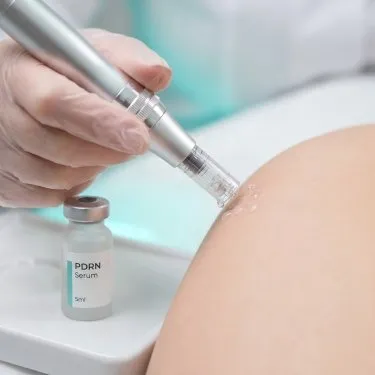
Most practitioners focus on what they are putting into the skin. Fewer think about when the skin is actually open to receive it.
Here is the reality: when a microneedling pen creates a channel, that channel does not stay open. Skin is elastic. The moment a needle withdraws, the surrounding tissue begins to contract. Depending on skin thickness, hydration state, and treatment depth, a micro-channel reaches roughly 50% closure within 4 to 8 seconds of needle withdrawal.
That is your absorption window.
If your PDRN serum is not inside that channel before it closes, it is sitting on the surface of skin that is already sealing itself. This is the elastic recoil behavior of dermal collagen fibrils—the single most underappreciated variable in microneedling infusion protocols.
The Biology: What Happens to a Micro-Channel in Real Time
Core Conclusion: A micro-channel begins closing within seconds due to collagen fibril elastic recoil and epidermal tight junction re-sealing. The practical absorption window is 4–8 seconds at standard skin hydration.
When a needle penetrates skin at 0.25mm to 1.0mm depth, it physically displaces the collagen fibrils in the dermis. These fibrils behave like compressed springs. The moment the needle retracts, the fibril network rebounds, pulling the channel walls inward.
Three things happen simultaneously:
- Elastic Recoil: Collagen fibrils contract back toward their resting position, narrowing the channel diameter.
- Platelet Aggregation: At depths above 0.5mm, platelets begin clustering at the channel entry point within seconds.
- Epidermal Tight Junction Re-sealing: Keratinocytes lining the channel edge begin signaling neighboring cells to close the gap.
What changes this window:
- Dry or dehydrated skin → closes faster (3–5 seconds)
- Pre-hydrated skin with prep mask → stays open longer (6–10 seconds)
- Higher needle density (H36 vs H12) → more simultaneous open windows
The Settings That Control Whether You Hit the Window
Core Conclusion: RPM controls how many channels you create per second. Pass speed controls how long any single zone is treated before you move on. Together, they determine whether your PDRN serum is present at the channel during the absorption window—or arriving after it closes.
RPM: The Channel Creation Rate
| RPM Setting | Channels per Second | Best Use Case |
|---|---|---|
| 6,000–9,000 RPM | ~100–150 per second | Sensitive skin, thin areas (periorbital, neck) |
| 10,000–13,000 RPM | ~166–216 per second | Standard treatment, balanced coverage |
| 14,000–18,000 RPM | ~233–300 per second | Scar tissue, thicker skin, high-volume coverage |
For PDRN infusion, 10,000–13,000 RPM is the optimal range. Above 15,000 RPM for extended passes, localized friction heat can begin to compromise PDRN bioactivity at the skin surface.
Pass Speed: The Variable Most People Ignore
| Cartridge Type | Recommended Pass Speed | Reasoning |
|---|---|---|
| Nano (0.2mm–0.5mm) | 1.5–2.0 cm/second | Shallow channels close faster; keep pace with serum flow |
| H12 (0.5mm–1.0mm) | 1.0–1.5 cm/second | Deeper channels stay open slightly longer; slower maximizes fill |
| H24 (0.5mm–1.0mm) | 1.0–1.5 cm/second | Higher pin density; consistent pace fills more simultaneous channels |
The Number of Passes: Why 3 Beats 6 for PDRN
By the 4th or 5th pass over the same zone, you are largely re-needling channels that have already closed and are now in the early inflammatory phase. You are not opening new absorption pathways—you are creating inflammation that will compete with PDRN’s A2A receptor repair signaling.
For PDRN infusion: 3 directional passes per zone (vertical → horizontal → diagonal) is the clinical standard.
Matching Billsu PDRN Serum to the Hydra Pen H5 Flow Rate
Core Conclusion: The Billsu Salmon DNA PDRN Serum is formulated at water-like viscosity specifically to flow through nano and H12/H24 cartridges without resistance—ensuring the serum reaches the channel during the 4–8 second absorption window, not after.
The Billsu PDRN serum (water, sodium hyaluronate, sodium DNA ≥5%, 1,2-hexanediol) was engineered for micro-fluidic infusion through a pen system. A gel-type or high-viscosity PDRN cannot flow through the H5’s micro-channels fast enough to be present at the channel before elastic recoil begins.
At 12,000 RPM with a 1.0 cm/second pass rate, the H5 creates approximately 120 channels per second. The serum flow rate through the 3ml cartridge delivers approximately 0.025ml per 10 channels—meaning every channel receives its dose at needle withdrawal, not minutes later.
The Full Protocol: Putting It Together
Step 1 — Skin Priming (15 minutes before)
Apply a hydrogel prep mask. Pre-hydrated skin extends the micro-channel absorption window from 4–5 seconds (dry skin baseline) to 7–10 seconds.
Step 2 — Load and Set
Load Billsu Salmon DNA PDRN Serum into the H5 3ml cartridge. Set RPM to 10,000–12,000. Select cartridge depth:
- Acne scars, post-treatment recovery → H12 at 0.5mm–0.75mm
- General regeneration, glow → Nano at 0.25mm–0.5mm
- Deeper repair, skin laxity → H24 at 0.75mm–1.0mm
Step 3 — Three-Pass Infusion
- Pass 1: Vertical strokes, 1.0–1.5 cm/second
- Pass 2: Horizontal strokes, same speed
- Pass 3: Diagonal strokes, same speed
Allow 30–45 seconds between passes for initial serum absorption before the next round of channels.
Step 4 — Seal and Lock
Apply remaining PDRN serum topically with light fingertip pressure immediately after the final pass. The skin surface remains permeable for 10–15 minutes post-treatment. Do not wipe.
Clinical Q&A
Q: Can I use the Billsu PDRN with the H36 cartridge at 1.0mm+ depth?
Straight answer: The Billsu serum is optimized for 0.2mm–1.0mm depth. At 1.0mm+ with H36, the serum will still infuse, but you are approaching the boundary where injectable-grade PDRN becomes clinically preferable for maximum bio-availability at depth. For most skin repair goals, 0.5mm–1.0mm with H12/H24 delivers the strongest ROI on this serum.
Q: How much serum does one treatment use?
Straight answer: A full-face protocol with 3 directional passes using H12 at 12,000 RPM consumes approximately 1.5ml–2.0ml. One 5ml Billsu PDRN vial covers a full face with serum remaining for the neck or décolletage. One vial per full-face session is the standard dosing.
Q: Why does my PDRN pool on the surface instead of absorbing?
Straight answer: Three common causes: (1) pass speed too fast—slow to 1.0 cm/second, (2) skin is dehydrated—add a 15-minute hydrogel prep step, (3) serum viscosity too high for the cartridge—use the Billsu water-formula PDRN engineered for pen-system flow rates.
Professional Use Only. Treatment depth, pass count, and RPM settings should be adapted based on individual client skin assessment and local professional guidelines.