$75 with free shipping, buy now!

PDRN for Microneedling: Why the Formula Matters More Than the Brand Name

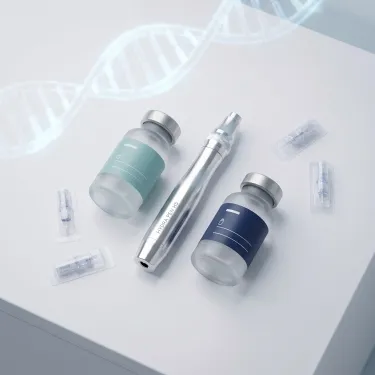
Every supplier will tell you their PDRN is the best. Korean-grade. Salmon DNA. Injectable quality. 5% concentration. The claims stack up fast.
Here is what most of them won’t tell you: PDRN does not work alone. The nucleotide fragments that make it valuable need specific conditions inside the formula to actually penetrate skin and trigger the A2A receptor response that drives repair. Without the right supporting ingredients, you are running an expensive serum through your Hydra Pen H5 cartridge and most of it is not doing what you paid for.
This is a guide to what those supporting ingredients are, why they matter more than the brand name on the label, and how to choose the right PDRN product for the treatment you are running.
First: Know Which “Type” You Are Buying
Core Conclusion: PDRN (short-chain) and PN (long-chain Polynucleotides) are not interchangeable. They have different molecular weights, different depths of action, and different clinical purposes.
| PDRN — “The Healer” | PN — “The Architect” | |
|---|---|---|
| DNA Chain Length | Short-chain fragments | Long-chain Polynucleotides |
| Primary Action | Rapid repair via A2A receptor activation | Deep structural rebuilding, collagen scaffolding |
| Best Use Case | Acne scars, post-treatment recovery, redness | Deep wrinkles, skin laxity, “liquid facelift” |
| Ideal Needle Depth | 0.2mm–0.5mm Nano, 0.5mm–1.0mm standard | 0.5mm–1.0mm standard microneedling |
| ROI Profile | High volume, fast turnover, visible results quickly | Premium pricing, fewer sessions, long-term clients |
| Client Profile | Post-acne, sensitive skin, frequent treatment | Anti-aging, high-spend clients seeking structural change |
The Real Variable: What Is IN the Formula With the PDRN
Core Conclusion: PDRN concentration tells you very little. The carrier ingredients—Hyaluronic Acid grade, penetration enhancers, and pH stabilizers—determine whether the DNA fragments actually reach the dermis or sit in the epidermis doing nothing.
1. Sodium Hyaluronate — The Carrier That Actually Delivers
Low-molecular-weight Sodium Hyaluronate (below 50kDa) penetrates the epidermis and pulls water-soluble actives—including PDRN fragments—deeper into the skin. If the ingredient list just says “aqua, sodium DNA” with no HA at all, the PDRN has no efficient carrier and absorption will be superficial.
2. 1,2-Hexanediol — The Penetration Enhancer That Keeps It Sterile
At 0.5%–1% concentration, this ingredient temporarily disrupts the tight junctions in the stratum corneum, opening a larger window for PDRN fragments to enter. It also provides preservative function without compromising DNA chain stability. For nano-needling, this is what separates a formula that actually works from one that just sits on the surface.
3. pH Stabilization — The Factor Nobody Reads on the Label
PDRN is stable between pH 6.5 and pH 7.4. Outside that range, the DNA chains begin to degrade—and you will never know it happened because the serum still looks the same in the vial. A professional PDRN formula should be buffered to physiological pH. No pH data on the spec sheet means you are taking a risk.
4. Sodium DNA Concentration — The Number That Actually Matters
What you want: total sodium DNA content ≥ 2% in a topical-grade formulation for nano-needling. For standard microneedling at 0.5mm–1.0mm, a higher concentration (3%–5%) is justified because you are bypassing the natural barrier more directly.
What Grade Do You Actually Need for Nano-Needling?
Core Conclusion: For nano-needling (0.2mm–0.5mm), injectable-grade PDRN is not necessary. A topical-grade formulation with the right carrier system delivers comparable absorption with significantly better cost economics for high-volume clinics.
Injectable-grade PDRN is produced under pharmaceutical sterility standards for direct dermal injection at 1mm–2mm depth. For nano-cartridges on the Hydra Pen H5, you are not reaching 1mm. You are creating micro-channels and relying on the formula’s transdermal penetration to do the rest. A correctly formulated topical-grade serum—clean ingredient list, right molecular weight HA, pH-buffered—will outperform a poorly formulated injectable-grade product at this depth, at a fraction of the cost.
How to Match Your PDRN Choice to Your Hydra Pen H5 Cartridge
| Cartridge Type | Recommended Grade | Formula Viscosity | Concentration Target |
|---|---|---|---|
| Nano (0.2mm–0.5mm) | Topical-grade | Low (water-like) | ≥2% sodium DNA |
| H12 / H24 (0.5mm–1.0mm) | Topical or semi-clinical | Low to medium | 3%–5% sodium DNA |
| H36 (1.0mm+) | Semi-clinical or clinical | Medium | 5%+ sodium DNA, buffered |
Higher viscosity serums will create flow resistance in nano cartridges. If your PDRN serum is noticeably thick or gel-like, it is formulated for topical application or syringe injection—not for a micro-fluidic pen system.
Clinical Q&A: The Questions That Actually Come Up
Q: A client wants “PDRN like Rejuran.” What do I tell them?
Straight answer: Rejuran uses long-chain PN (Polynucleotides), not short-chain PDRN. If a client is referencing Rejuran, they are asking for structural rebuilding—the “Architect” profile. A standard PDRN repair serum will not produce the same outcome. You need a PN-dominant formula at 0.5mm–1.0mm depth with the H5’s standard cartridge, not the nano tip.
Q: Can I mix PDRN with other serums in the H5 cartridge?
Straight answer: Only if pH and viscosity are compatible. Mixing PDRN with Vitamin C (low pH) will degrade the DNA chains within minutes. Mixing with neutral-pH peptides is generally safe. When in doubt, run single-ingredient serums and layer topically after the treatment.
Q: How do I know if a cheap PDRN option has degraded?
Straight answer: You usually cannot tell by looking at it. Best proxies: (1) request a CoA (Certificate of Analysis) with sodium DNA concentration confirmed by lab test, and (2) verify cold-chain shipping. PDRN degrades rapidly above 25°C. If a supplier ships without cold chain, the product you receive is not the product that left the lab.
Professional Use Only. PDRN and PN product selection should be based on treatment depth, client skin profile, and applicable local regulations. Always verify supplier CoA and storage specifications before clinical use.
Sourcing
- Hydra Pen H5 — Nano to H36 Cartridge System
- Original Hydra Pen H5 Cartridges — Nano / H12 / H24 / H36
- PDRN & PN Serums — Coming Soon to Billsu