$75 with free shipping, buy now!

The Physics of Intradermal Injection: Overcoming Flow Resistance in 34G Multi-Needles for Skin Booster Therapy

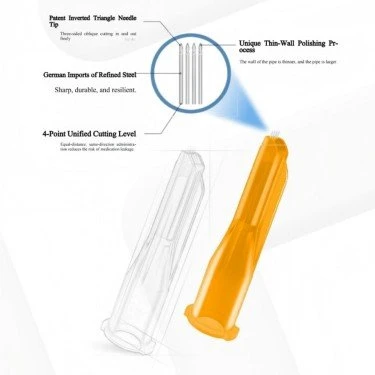
With the global rise of advanced skin boosters like Polynucleotides (PN), Exosomes, and high-density Hyaluronic Acid, mesotherapy has transitioned from a manual art to a precise science. However, as clinics adopt ultra-thin needles like 34G 4-pin multi-injectors to minimize patient bruising, they face a common technical challenge: high flow resistance (the “hard to push” phenomenon).
Understanding the fluid dynamics of intradermal delivery is crucial for practitioners who want to eliminate product leakage, prevent hand fatigue, and ensure precise depth delivery. This report provides the scientific backing for managing back-pressure during 34G multi-needle therapies.
The Fluid Mechanics of 34G Needle Resistance
Core Conclusion: According to the Hagen-Poiseuille law, flow resistance increases exponentially as the needle’s internal diameter decreases. A 34G needle (0.18mm outer diameter) requires up to 5 times more injection pressure than a 30G needle when administering high-viscosity skin boosters.
When forcing a viscous hyaluronic acid or DNA serum through a 34G needle, the fluid experiences high wall shear stress.
- The Resistance Formula: Flow resistance is inversely proportional to the fourth power of the needle’s inner radius (R4). Even a microscopic decrease in needle diameter leads to a massive spike in the pressure required to execute the injection.
- Dermal Back-Pressure: The dense, fibrous tissue of the dermis resists fluid displacement, creating a “back-pressure” that can cause serum leakage (backflow) if the needle is not stabilized correctly.
Technical Comparison: Needle Gauge vs. Flow Mechanics
| Needle Specification | 30G (Standard) | 32G (Fine) | 34G (Ultra-Fine / FITTER 4-Pin) |
|---|---|---|---|
| Outer Diameter | 0.31 mm | 0.23 mm | 0.18 mm |
| Inner Diameter | 0.159 mm | 0.108 mm | 0.084 mm |
| Relative Flow Resistance | Baseline (1x) | 4.6x | 12.8x |
| Dermal Trauma & Bruising | Moderate | Low | Near-Zero |
| Ideal Serum Viscosity | High (Dermal Fillers) | Medium | Light-to-Medium (PN/PDRN/Peptides) |
Why 1.2mm is the Golden Depth for 4-Pin Meso Needles
At a fixed depth of 1.2mm, the FITTER 4-Pin needle targets the papillary dermis. This is the optimal layer because the collagen fibers are less dense here than in the deep reticular dermis, which slightly lowers the dermal back-pressure and allows the skin booster to diffuse evenly without forming hard nodules.
Sourcing Standard: FITTER 4 Pin-34G 1.2mm Multi Injector Needle (Box of 20)
Clinical Troubleshooting: Overcoming Resistance in Practice
To resolve the “hard to push” issue during high-viscosity treatments, clinical engineers recommend two key adjustments:
1. The Epidermal Stretching Technique
Why it works: When the skin is lax, the needle pushes the tissue downward instead of penetrating it, increasing mechanical resistance and causing pain. By stretching the skin tight between your fingers before insertion, you increase the tension of the stratum corneum. This allows the 34G needle to puncture cleanly at exactly 1.2mm, reducing back-pressure and preventing serum leak-back.
2. Viscosity Dilution or Temperature Management
For highly dense serums, warming the vial to room temperature (22°C–25°C) slightly lowers the fluid viscosity, significantly reducing the pressure required to push the serum through the 0.084mm internal diameter of a 34G needle.
Q&A: Troubleshooting Multi-Needle Injections
Q: Why do 4-pin needles feel harder to inject than single needles?
Fast Answer: Injecting through four 34G needles simultaneously divides the plunger force across four ultra-narrow channels. Because each channel has high friction, the total force required to push the syringe increases. Stretching the skin tight and using a high-torque luer-lock syringe resolves this.
Q: Can I use thick dermal fillers with 34G 4-pin needles?
Fast Answer: No. 34G needles are engineered specifically for liquid skin boosters, PDRN, exosomes, and hair peptides. High-viscosity cross-linked fillers will block the micro-channels and should be administered with 30G or larger needles.
Optimizing the Protocol with “Prep & Calm”
Because 34G needles require firm mechanical skin contact, prep is essential.
Applying the Prep & Calm Mask for 15 minutes before the procedure vasoconstricts the blood vessels (minimizing the risk of hitting capillaries) and desensitizes the skin. This allows the practitioner to apply the necessary skin-stretching pressure without causing discomfort to the patient.
Conclusion: Precision Over Force
The transition to ultra-fine 34G 4-pin needles represents a massive leap forward in patient comfort. However, mastering this technology requires understanding the physics of fluid resistance. By applying the epidermal stretching technique and choosing the correct viscosity, clinics can deliver high-value skin boosters with zero pain, zero waste, and maximum clinical accuracy.